
Anna Ehrenstein (b. 1993) is an interdisciplinary artist weaving multipolar cosmogony between Berlin, Tirana, and the cloud. She is a professor in the photography department at HGB Leipzig.
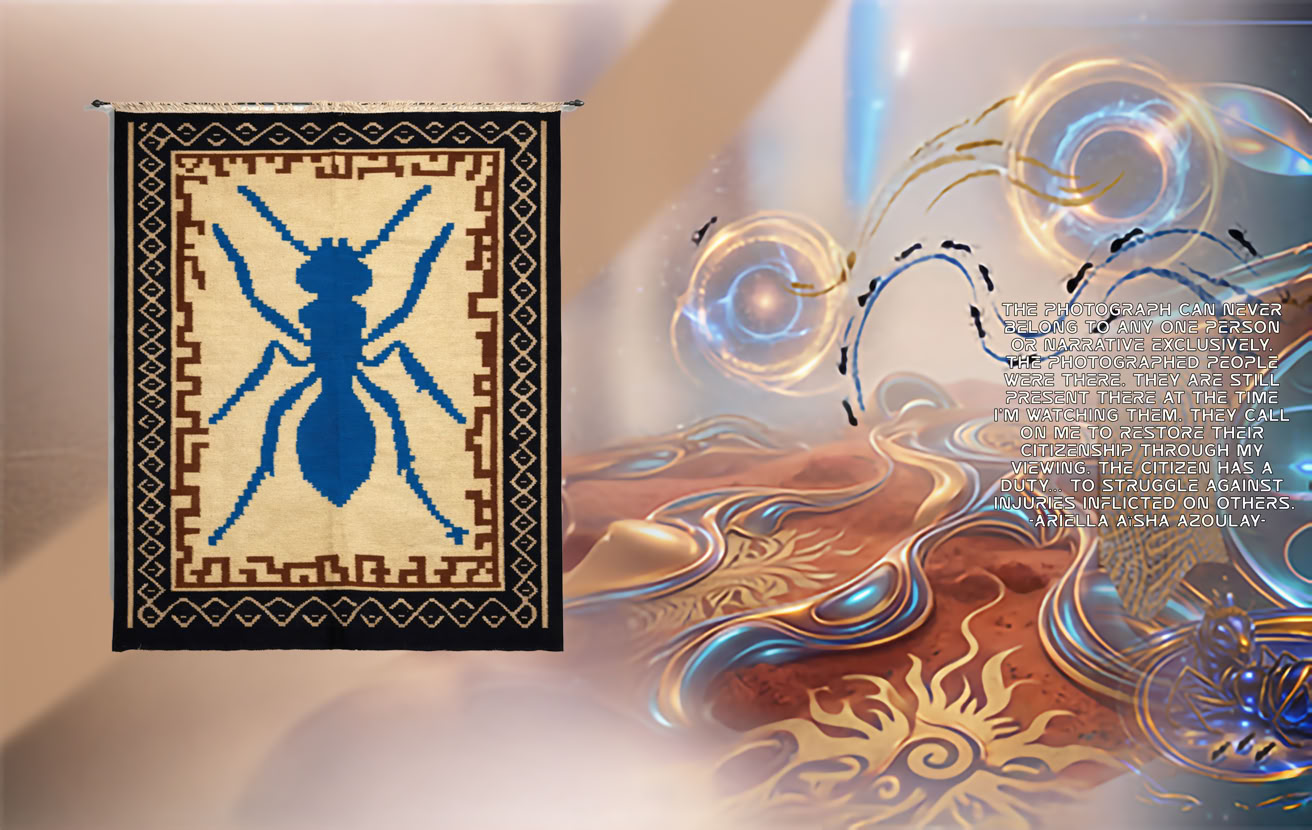
LANGUAGE OF THE SOIL (2026)
Organic-Mechanical Hybrids, Digital Economies, Colonial
Legacies, and Collective Futures
It all starts with the soil, from where echoes of human labor arise. From there, they reach out to us, glowing, sparkling, flashing. Evaporating golden mist forming clouds in the sky—to augment our bodies and minds. To inspire us. To haunt us. Always watching silently. But the soil never forgets. Toiling, sweating, a choreography of hands, eyes, nerves, and imaginations keeps the system alive. Their chorus reflects back to us and shatters the illusion. Language of the Soil moves through these undercommons of digital production in recognition of its intelligence, its rhythms, and its refusals. Developed by Anna Ehrenstein together with researchers, designers, and digital workers who—loudly, politically, and on their own terms— train Large Language Models, deceptively labelled as ‘Artificial’ Intelligence, the project traces how people organize, narrate, and imagine from inside infrastructures built to mute them. Weaving together a sculptural and cinematic installation, digital labor, and Science and Technology Studies, this speculative work cycle draws on multi-faceted and pluridisciplinary research based on fieldwork in Nairobi, Kenya and Cairo, Egypt. Moving through a mythological hybrid landscape blending organic and mechanical parts, interviews, workshops, and collective storytelling are condensed to create a speculative 360° video narrative. The project features contributions by co-collaborators Ariana Dongus, Fasica Berhane, Mophat Okinyi, Richard Mathenge, Dalton Odiyo, Zana Hoxha, and Ibrahim Ahmed, crafting together futuristic set design and costumes, 3D-printed and hand painted sculptural works and photographic assemblages. The work cycle is animated by the social and environmental contradictions of a world increasingly shaped by AI, automation, and platform economies. The lived reality of platform workers—particularly in the Global South—often remains obscured. Women and displaced populations are disproportionately exposed, as platform labor intersects with unpaid reproductive work, legal precarity, and historically gendered regimes of extraction.
The daily expenditure of digital labor
in Nairobi, a major
site for outsourcing content
moderation and AI data annotation,
exemplifies how historical patterns
of colonial extraction and control
persist within the structures of
the digital economy. Various
international companies engage
Kenyan outsourcing firms for AI
training and content moderation,
paying wages lower than $2 per
hour, as a 2023 investigation
found. Recently, Chinese companies
have entered the market, as well.
While for some,
machines become extensions of their
senses, others become extensions
of the machines.
“I clicked until my eyes
bled, I labelled until
I forgot my name.”
Text Faheem Hemboum

Language Of The Soil looks at the manual labour of AI and the wisdom of the soil.


